
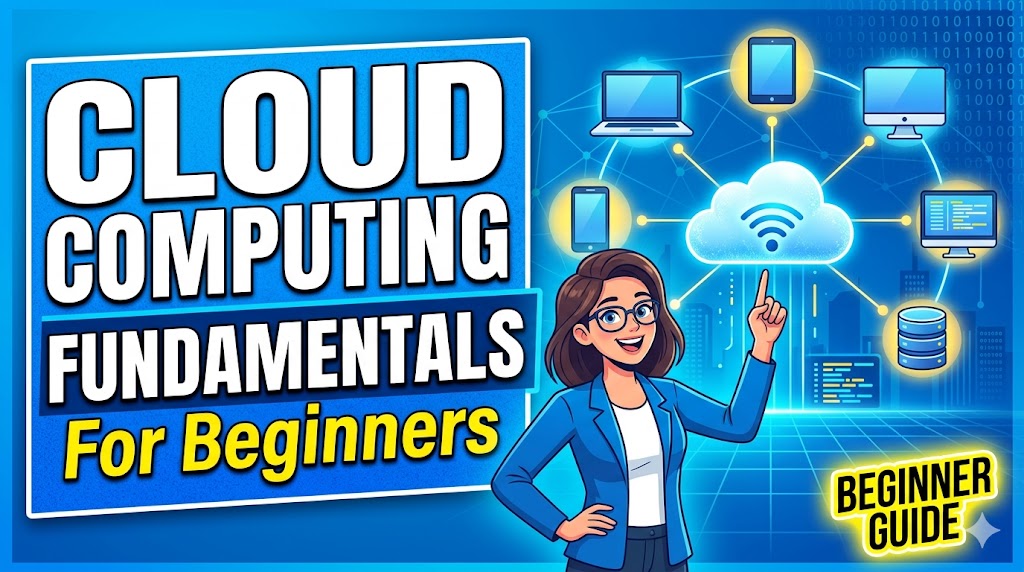
Course Overview
Welcome to "Cloud Computing Fundamentals for Beginners". This course introduces beginners to cloud computing in a clear and practical way. It is designed for learners with no technical background who want to understand how cloud technology works and how it is used in everyday life and business. The course focuses on concepts, real-world examples, and decision-making rather than complex infrastructure or programming.
Why Take This Course?
Cloud computing exists to solve major limitations of traditional computing systems. In the past, individuals and organizations had to install software locally or build their own servers, which required significant investment in equipment, maintenance, and technical management. Cloud computing transforms this model by allowing users to access resources remotely—all they need is an internet connection.
By mastering these fundamentals, you will understand how cloud computing provides practical advantages for both personal and professional environments:
Benefits for Individuals: Cloud tools allow users to access their documents, notes, and tasks from anywhere with an Internet connection. This enables flexible work across multiple devices, automatic data synchronization to prevent information loss, and real-time collaboration with friends or colleagues.
Benefits for Businesses: One of the greatest advantages of cloud computing is its ability to scale resources on demand. Businesses can increase or decrease computing power and storage as needed, optimize IT budgets through a pay-as-you-go model, and drive innovation by accessing advanced technologies like data analytics and artificial intelligence.
Detailed Course Modules
Module 1: The Core Concepts and Everyday Examples
Cloud computing refers to using computing resources over the internet instead of owning and maintaining physical hardware.
The Infrastructure: These resources include data storage, software applications, servers, databases, and processing power. You will learn how the internet acts as a connection bridge, allowing users' devices to communicate with powerful remote servers housed in secure data centers.
Real-World Recognition: Cloud computing can seem abstract at first, but most people already use cloud-based services every day. You will explore familiar examples such as email services, online file storage and backup, streaming media services, and mobile apps that sync data across devices.
Module 2: Cloud Service and Deployment Models
Cloud computing offers different types of services depending on how much control and responsibility users want.
Service Models: You will be introduced to Software as a Service (SaaS) for ready-to-use software like video streaming platforms. You will explore Platform as a Service (PaaS), which provides a platform where developers can build and test applications. Finally, you will learn about Infrastructure as a Service (IaaS), which provides virtual computing resources like servers for users needing high control.
Deployment Models: You will explore the Public Cloud, which is shared by many users and offers lower costs. You will contrast this with the Private Cloud, which is used by only one organization and offers higher security and privacy. You will also examine the Hybrid Cloud, which combines both public and private clouds to balance flexibility and control.
Module 3: Security, Risks, and Practical Usage
While cloud computing offers many advantages, there are several risks and limitations that users and organizations should carefully consider.
Understanding Risks: When data is stored in the cloud, it is no longer under the user's full physical control, which increases the risk of data breaches. Other limitations include dependence on Internet connectivity and the potential for vendor lock-in, where migrating to another platform can be costly and complex.
Cloud Security Basics: You will learn the shared responsibility model, which states that security is shared between the provider and the user. The provider secures the physical infrastructure, while the user is responsible for managing accounts, passwords, and setting access permissions. You will practice basic security habits like using strong passwords, enabling two-factor authentication, and performing routine data backups.
Module 4: Cost Management and Real-World Implementation
In cloud computing, cost management is essential to prevent misuse and overspending.
Pricing Structures: You will learn about different pricing models, including pay-as-you-go, subscription plans, and reserved plans with discounted pricing. You will discover how to avoid hidden costs, such as data transfer fees and excess storage charges.
Applying Cloud Thinking: Learning about cloud computing should go beyond theory. You will apply cloud concepts to hypothetical or real-world scenarios, such as using cloud storage for an online shopping website or setting up automatic backups to protect customer data.
Course Summary
The course concludes by emphasizing that cloud computing is not just a technology—it is a mindset. A cloud-first mindset promotes flexibility, continuous learning, and adaptability in an ever-evolving digital environment.
Adopting this mindset does not mean blindly using cloud solutions for everything; rather, it involves considering cloud solutions as a primary option when designing systems and adapting quickly to changes in business or user demands. By actively updating your knowledge and viewing technology as a long-term strategy, you will be equipped to develop future-ready systems, optimize resource management, and foster a culture of ongoing innovation